Back to School Digital Papers: A Strategic Resource for Creators, Educators, and Small Business Owners
If you work with visual content — whether for classrooms, marketing materials, client projects, or personal branding — you know that the right asset can change the tone and impact of everything you produce. Back to School Digital Papers are not just decorative files. When approached with intention, they become a practical resource for streamlining creative work, reinforcing messaging, and saving time across multiple projects. This article examines what these digital papers are, why they matter for professionals and creators, and how to use them strategically rather than randomly.
What Back to School Digital Papers Actually Are
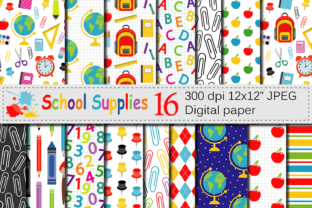
At their core, Back to School Digital Papers are high-resolution image files — 16 JPG files at 300 DPI, each sized at 12 x 12 inches. They come ready for both print and digital use, which means you can place them into presentations, slide decks, worksheets, social media graphics, product packaging, or printed classroom materials without additional processing. The “back to school” theme typically includes patterns and textures that evoke academic settings: notebooks, pencils, chalkboards, apples, rulers, and geometric school motifs. But the practical value goes beyond the theme.
For a teacher preparing a classroom newsletter or a small business owner designing a fall marketing campaign, these papers serve as a consistent visual foundation. They reduce the need to create patterns from scratch and allow you to focus on layout, messaging, and audience engagement. Because they are 300 DPI, they reproduce cleanly in print, and because they are JPG files, they integrate easily into common design software, document editors, and even presentation tools.
Why Thoughtful Use of Back to School Digital Papers Matters for Your Goals
Using any design asset without a clear purpose wastes time and dilutes your message. Back to School Digital Papers are no exception. However, when you align them with specific goals, they become a tool for consistency, efficiency, and even brand recognition.
Consider a freelance curriculum designer who creates weekly activity packets for parents. By selecting a coordinated set of digital papers, that designer can produce a cohesive series of worksheets, cover pages, and instruction sheets. Parents begin to recognize the visual language, which builds trust and reduces confusion. For a small business selling educational products, using the same paper set across product listings, social media posts, and printed inserts creates a unified customer experience. This consistency supports branding without requiring a full design overhaul each season.
From a productivity standpoint, having a pre-made set of 16 coordinated papers eliminates decision fatigue. Instead of searching for a pattern that works, you pull from a curated collection. For time-constrained educators and entrepreneurs, that saved time directly impacts output and reduces creative burnout.
Strategic Planning: When to Use Back to School Digital Papers
The value of these papers is highest when you plan their use around a calendar, a campaign, or a content series. Random insertion rarely produces strong results. Strategic timing does.
- Back-to-school season (August–September): This is the most obvious window. Classroom newsletters, welcome packets, supply labels, and first-day activities all benefit from themed visuals. For business owners, this is a prime time to launch school-related products, email sequences, or social media content.
- Year-round academic content: If your work involves tutoring, homeschooling, after-school programs, or educational publishing, these papers can appear in materials throughout the academic year. They provide a consistent visual thread across months of content.
- Product launches and promotions: Whether you sell digital planners, printable wall art, or physical classroom supplies, using Back to School Digital Papers as backgrounds or accent elements in your marketing assets creates a timely, cohesive look.
- Client projects and presentations: Freelancers and agency professionals can use these papers to quickly build mood boards, concept mockups, or client presentations that feel thematic without requiring custom illustration.
When you map out your projects in advance, you can assign specific papers to specific uses. For example, a subtle notebook pattern might work best for a background, while a bold apple motif suits a header or border. This kind of intentional assignment prevents the common mistake of using every paper in every project, which leads to visual clutter.
Practical Examples That Move Beyond Decoration
To understand the real utility of Back to School Digital Papers, consider a few grounded scenarios.
Example 1: A teacher creating a classroom binder set. With 16 papers at hand, this teacher can create a cover page, divider tabs, a weekly schedule insert, and a parent communication log — all using coordinated patterns. The result is a professional-looking system that students and parents take seriously. The teacher did not need design skills; they only needed a basic document editor and a clear plan.
Example 2: An educational influencer growing a social media presence. Instead of shooting new background photos for every post, the influencer uses Back to School Digital Papers as consistent backdrops for quote graphics, product showcases, and tip cards. Followers begin to associate the visual style with the brand, increasing recognition and engagement. The papers also allow for quick content creation during busy weeks.
Example 3: A small business owner selling printable study planners. By using the same paper set across product previews, listing images, and bonus inserts, the owner ensures that every customer touchpoint feels unified. This reduces returns caused by mismatched expectations and builds a more professional storefront.
In each case, the digital papers are not the star — they are the supporting element that elevates the entire project. That is the difference between decoration and strategic use.
What to Consider Before Relying on Back to School Digital Papers
No resource is a perfect fit for every situation. Before committing to a set, evaluate your actual needs. Ask yourself:
- Does the theme match my audience and message? If your content is targeting high school or college students, a set with very juvenile motifs may not resonate. Conversely, if you work with early childhood education, playful patterns are ideal.
- Do I have the technical ability to use JPG files effectively? Most modern tools accept JPGs, but if you work in a platform that requires transparent backgrounds (like certain print-on-demand setups), you may need to layer these papers inside a design application that supports opacity.
- Will I use enough of the set to justify the investment? A 16-paper set offers variety, but if you only need one or two patterns, a smaller collection might suffice. For those creating diverse projects, the full set provides flexibility.
Another consideration is file size. At 300 DPI and 12 x 12 inches, these files are large. That is excellent for print quality, but it can slow down loading times in online design tools or email attachments. If you work primarily in digital channels, you may want to downsample copies for faster performance, while keeping the originals for print.
Risks of Using Back to School Digital Papers Without Clear Goals
It is easy to fall into the trap of using a themed asset simply because it looks appealing. Without a clear objective, the result can be inconsistent branding, mismatched aesthetics, or wasted effort. For example, if you use a bright, dense pattern as a background behind text, readability may suffer. If you combine multiple papers in one project without a unifying color or style, the final piece can feel chaotic rather than cohesive.
Another risk is over-reliance on one set. If you use the same 16 papers for every project for an entire year, your audience may experience visual fatigue. The novelty fades, and your content starts to feel repetitive. To avoid this, treat the papers as one tool in a larger creative kit. Rotate them with other assets, vary your layouts, and use them sparingly where they add the most value.
There is also a subtle branding risk. Because Back to School Digital Papers are a commercial product, other creators may purchase and use the same set. If your brand relies heavily on a specific pattern, and a competitor uses it in a similar way, your visual identity could become diluted. Mitigate this by combining the papers with your own logo, color palette, typography, and photography. The papers should complement your brand, not define it.
How to Use Back to School Digital Papers Intentionally
Intentional use begins with a simple question: What outcome do I want this project to achieve? Once you answer that, the papers become a means, not an end. Here is a decision-making framework:
- Define the project goal. Is it to inform, sell, teach, or engage? Every design choice should support that goal.
- Select papers that reinforce the message. For a calming classroom guide, choose muted, simple patterns. For an energetic sale announcement, pick bright, bold motifs.
- Limit your palette. From the 16 papers, choose 2–4 that work together. This prevents visual overload and creates a recognizable system across your materials.
- Test readability and hierarchy. Place text over the paper and check contrast. Adjust font weight, size, or color to ensure the message is clear.
- Use papers as accents, not backgrounds everywhere. A border, a header strip, or a small inset can add theme without overwhelming the content.
- Keep a usage log. If you are using the papers across multiple projects, note which patterns you have used and where. This helps you rotate effectively and avoid repetition.
This approach turns a simple file set into a deliberate workflow. It also makes it easier to evaluate what worked and what did not, so you can refine your choices in future projects.
Long-Term Value: Building a Reusable Asset Library
One of the most overlooked advantages of Back to School Digital Papers is their reusability. Because they are generic in theme but specific in quality, they can be stored and reused year after year. A teacher who downloads this set in August can use it for that entire school year and again the following fall. A business owner can incorporate the same papers into annual campaigns, updating only the text and layout each time. This reduces repetitive design work and builds a library of consistent visual assets.
From a financial perspective, the cost per use becomes very low when you reuse the papers across multiple projects. That makes them a smart investment for anyone who produces school-related content regularly. Over time, you will also develop a keener eye for which patterns work best for which contexts, further improving your efficiency and output quality.
For professionals who manage multiple clients or content streams, having a go-to set for back-to-school projects saves proposal time, reduces revision cycles, and helps you deliver polished work faster. The papers become part of your operational toolkit, not just a creative indulgence.
Final Observations on a Practical Resource
Back to School Digital Papers are not a magic solution, nor are they a substitute for strong design thinking. But they are a genuinely useful resource when you understand what they are and how to deploy them. The 16 JPG files at 300 DPI, sized at 12 x 12 inches, give you a professional-grade foundation that works across print and digital environments. For teachers, parents, students, and the professionals who serve them, these papers can reduce busywork, reinforce visual consistency, and free up mental energy for the tasks that truly require your attention.
The key is to approach them strategically: plan your use, align them with your goals, and avoid the temptation to treat them as mere decoration. When used with intention, Back to School Digital Papers become a reliable part of your creative practice — one that supports better outcomes for your audience and your work.