The Enduring Legacy of the Rumpelstiltskin Fairy Tale: Origins, Characters, and Creative Applications
Believed to have originated as far back as 4,000 years ago, the Rumpelstiltskin fairy tale is one of the most haunting and memorable stories in the Western canon. Most famously recorded by the Brothers Grimm in their 1812 collection, the narrative of a miller's daughter forced to spin straw into gold under threat of death, and the mysterious imp who comes to her aid at a terrible price, has captivated audiences for generations. The tale's enduring power lies not only in its magical elements but in its deep psychological and moral undercurrents, making it a fertile subject for educators, storytellers, and artists alike. Understanding the story's ancient roots, its cast of compelling characters, and the symbolic weight of its objects provides a rich foundation for anyone looking to use this fairy tale in creative or educational contexts.
Origins and Historical Context of the Rumpelstiltskin Story
The Rumpelstiltskin fairy tale belongs to a class of stories known as "Rumpelstiltskin-type tales," which appear in folklore across Europe, Asia, and Africa. Scholars have traced its core motif—a supernatural being who helps a protagonist in exchange for a future child or possession—back to ancient oral traditions. The version most familiar today was popularized by the Brothers Grimm, but variations exist in cultures from Scotland to Scandinavia to the Middle East. The fact that the story may be four millennia old speaks to its resonance with fundamental human anxieties: the fear of being unable to meet impossible demands, the desperation of bargaining with unknown forces, and the hope of outsmarting a seemingly unbeatable adversary. The name "Rumpelstiltskin" itself, which in the original German suggests a noisy, clattering little goblin, adds a layer of grotesque charm that has ensured its place in popular memory.
For educators and professionals working with fairy tales, understanding these origins adds depth to any presentation. When teaching the Rumpelstiltskin fairy tale, it is valuable to discuss how different cultures have reinterpreted the story's central conflict. In some versions, the helper is a dwarf; in others, a demon or a forest spirit. This cross-cultural perspective can enrich classroom discussions about folklore, morality, and the shared human experiences that give rise to such tales. The clip art set that includes the miller's daughter, the mysterious imp, and the key objects from the story becomes more than just a visual aid—it becomes a gateway to exploring linguistic and cultural variations of the same narrative thread.
Key Characters and Their Symbolic Roles
The cast of the Rumpelstiltskin fairy tale is small but powerfully symbolic. Each character represents a facet of human experience and social structure, making the story rich for analysis and creative use.
The Miller's Daughter
The miller's daughter is the central human figure whose plight drives the narrative. She is initially a passive victim of her father's boast and the king's greed, but over the course of the story she demonstrates resourcefulness, resilience, and ultimately cleverness. In the clip art set, she is shown in a couple of poses—likely conveying her despair in the straw-filled room, her relief when the imp appears, and her later status as queen. These poses allow educators to visually depict her emotional journey from helplessness to empowerment.
The Mysterious Being Who Spins Straw Into Gold
Rumpelstiltskin himself is one of folklore's most memorable antagonists. He is not purely evil; rather, he is a trickster figure who operates on a strict code of bargains and debts. His demand for the miller's daughter's firstborn child introduces a primal fear of losing one's offspring. Yet his downfall—brought about by the queen's cleverness in discovering his name—adds a layer of justice to the tale. The clip art set captures his enigmatic nature, allowing creators to depict the moment of spinning, the exchange of the ring and locket, and the final confrontation.
The King and the Prince
In the Grimm version, the king who sets the impossible task eventually marries the miller's daughter. This character represents arbitrary power and the exploitation of the vulnerable. The prince who marries her is sometimes depicted separately in adaptations, symbolizing the social mobility and romantic resolution that the story offers. The clip art set includes the prince, making it easy to illustrate the transition from captive to queen.
The Objects: Straw, Gold, Ring, Locket, and the Firstborn Child
Every object in the Rumpelstiltskin fairy tale carries symbolic weight. The straw represents something worthless but abundant; the gold, the ultimate material desire. The ring and locket that the miller's daughter trades on the first two days are personal possessions that she sacrifices in desperation. The firstborn child is the ultimate price—a future life in exchange for present survival. The clip art set includes all these elements: straw, gold, ring, locket, and the baby. For teachers and librarians, having these visuals makes abstract concepts tangible, especially when discussing themes of value, sacrifice, and bargaining.
Thematic Depth and Moral Lessons in the Fairy Tale
The Rumpelstiltskin fairy tale operates on multiple thematic levels, which is why it remains relevant for both children and adults. On the surface, it is a story about keeping promises and the dangers of making deals with strangers. Deeper readings reveal themes of power, gender, and the value of knowing someone's true name—a concept rooted in ancient beliefs about names holding magical power. The queen's act of learning Rumpelstiltskin's name is an act of reclaiming agency, turning the tables on the imp who thought he had trapped her forever.
For educators, these themes provide rich material for discussion. A teacher using the clip art set might ask students to consider what the gold represents in the story, or why the queen's knowledge of the name is so powerful. The black and white versions of the clip art can be used for coloring pages, allowing younger children to engage with the story visually while older students can create their own storyboards or comic strips that explore the moral dilemmas. Librarians hosting a story time can use the color versions on fliers and handouts to generate interest, and the visual consistency of the set helps build a cohesive narrative environment.
Modern Educational and Creative Uses of the Rumpelstiltskin Tale
Today, the Rumpelstiltskin fairy tale is used in a wide variety of settings. In primary classrooms, it serves as a classic example of the fairy tale genre, helping students identify story elements like setting, characters, conflict, and resolution. In more advanced language arts curricula, the story is analyzed for its symbolic content and its place in oral tradition. Therapists and librarians sometimes use the tale to explore themes of fear, negotiation, and self-advocacy with children. The clip art set is an invaluable resource in these contexts because it provides ready-made visuals that align with the story's traditional imagery.
For creators such as authors, illustrators, and curriculum designers, the ability to use both color and black and white versions of the same characters and objects is a major advantage. Color versions can be used in digital presentations, newsletters, or classroom posters, while black and white versions are ideal for coloring activities, worksheets, and printable handouts. The inclusion of multiple poses for the miller's daughter means that a single set can convey an entire emotional arc without needing additional images. Similarly, having the imp, the ring, the locket, the straw, and the gold all in one collection saves time and ensures visual consistency across projects.
Practical Resources for Storytelling: The Rumpelstiltskin Clip Art Set
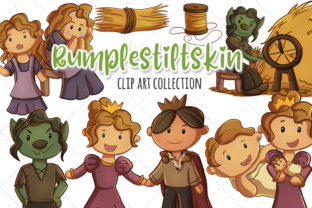
This clip art set is designed for anyone who needs to create a storybook setting around the Rumpelstiltskin fairy tale. Included in the set are the miller's daughter in a couple of poses, the mysterious being who appears and spins the straw into gold, the ring and locket she trades him on the first two days, the prince who marries her, and the firstborn child who the mysterious imp demanded for his services. There is also plenty of straw and gold to set the scene. The set is available in both color and black and white, making it versatile for different media and audiences.
Teachers can use the images on fliers to promote a fairy tale unit, on handouts for students to sequence the story, or as coloring pages that reinforce reading comprehension. Librarians can incorporate the clip art into bulletin board displays, reading logs, or event announcements for story hours. Daycare providers might use the black and white images as simple coloring sheets that introduce young children to a classic tale. For anyone involved in creating educational or recreational content about fairy tales, this set reduces the time spent searching for suitable visuals and ensures that all elements of the story are represented in a cohesive style.
Use Cases for Different Professionals
- Teachers: Use the color images in slideshows or on anchor charts to illustrate the sequence of events. The black and white versions work well for student worksheets, sequencing activities, or take-home story packets.
- Librarians: Create eye-catching event posters or bookmarks featuring the imp spinning straw into gold. The set can also be used to build a fairy tale themed reading corner with consistent visuals.
- Daycare Providers: Print the black and white pages for simple coloring activities that develop fine motor skills while exposing children to a classic narrative. The recognizable characters help spark storytelling and imaginative play.
- Curriculum Designers: Incorporate the images into printable storybooks, lesson plans, or digital resources. Having both color and black and white options allows for cost-effective printing without sacrificing quality.
- Hobbyists and Creators: Use the set to design personalized storyboards, craft projects, or social media content about fairy tales. The consistent style ensures a professional look across different platforms.
Considerations for Selecting Visual Aids for Fairy Tale Projects
When choosing clip art for educational or creative projects, several factors come into play. The visuals should be faithful to the story's traditional imagery so that children and adults alike recognize the characters and objects. The Rumpelstiltskin fairy tale has a distinctive visual identity—straw, gold, a spinning wheel, a mysterious imp, and a queen with a baby—and a set that includes all these elements saves the user from having to mix different artistic styles. The availability of both color and black and white versions is also important, as it expands the range of possible uses. Color images are perfect for digital or full-color print projects, while black and white images are ideal for photocopying, coloring, or ink-saving printing.
Another consideration is the flexibility of the poses. Having the miller's daughter in a couple of poses allows the user to show her in different emotional states without needing multiple character sets. The same principle applies to the imp: a single pose is useful, but having a version that shows him spinning, or interacting with the miller's daughter, adds narrative depth. For anyone creating a storybook setting, the ability to layer these images onto backgrounds or combine them with text is a significant advantage. The inclusion of props like straw, gold, ring, locket, and the baby further enhances storytelling possibilities, enabling the creation of complete scenes from a single resource.
Finally, it is worth noting that the same visual set can be used across different age groups and proficiency levels. Early learners benefit from simple, recognizable images that support comprehension, while older students can use the same images for more complex tasks like character analysis, story mapping, or creative writing prompts. The Rumpelstiltskin fairy tale clip art set is thus not just a collection of pictures but a versatile teaching and creative tool that adapts to the needs of its user. Whether the goal is to illustrate a lesson, decorate a classroom, engage a library audience, or provide a fun coloring activity, this set delivers the core visual elements of a story that has resonated for thousands of years.
In practice, the clip art becomes a bridge between the ancient oral tradition of the Rumpelstiltskin fairy tale and modern methods of communication. By providing clear, recognizable depictions of the miller's daughter, the imp, the prince, the baby, and the objects that define the plot, it allows educators and creators to focus on the narrative and its themes rather than on sourcing or adapting artwork. The inclusion of both color and black and white versions ensures that the set can be used in environments with limited printing resources without sacrificing clarity or appeal. For anyone committed to bringing the magic and moral complexity of this four-thousand-year-old story to a new generation, having a dedicated visual toolkit makes all the difference.